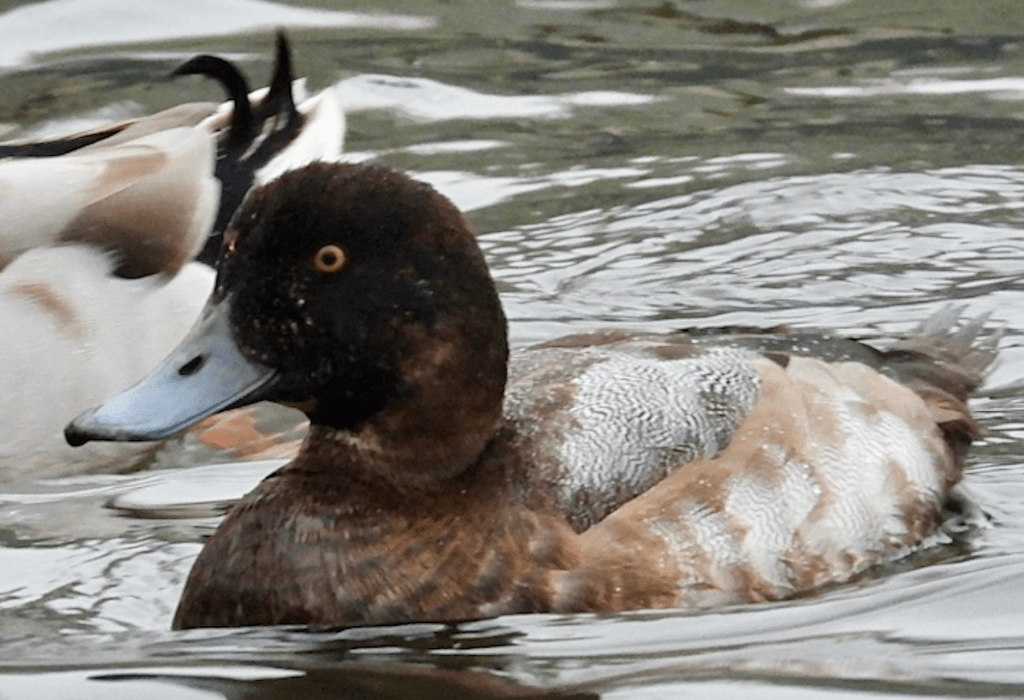
Picture by Tom Parkinson
On Saturday I took part in a Cumbria Bird Club outing at Foulney. If you’ve never been I recommend it. Basically you walk out from Roa Island causeway near Barrow and get cut off by the tide. You’re then treated to great views of a couple of thousand Eider and hopefully something a bit more scarce before the tide recedes and you come off again.
We had a lovely time but we were down on our luck in terms of a scarce seabird to cap off a great trip. Slavonian Grebe, Great Northern Diver or Long-tailed Duck were the kind of thing we hoped for. A Long-tailed Duck was seen off Blackpool (we could clearly see the Tower) and no fewer than three were at Millom but we drew a blank.
Fast forward to Sunday and it was pretty grim weather in Blackpool, but I had a couple of hours to spare whilst Jane was hospital visiting so I went to do the Stanley Park monthly wildfowl count. I had counted a group of Tufted Ducks when I registered that one had grey coming through on the upperparts. So actually a Greater Scaup then.
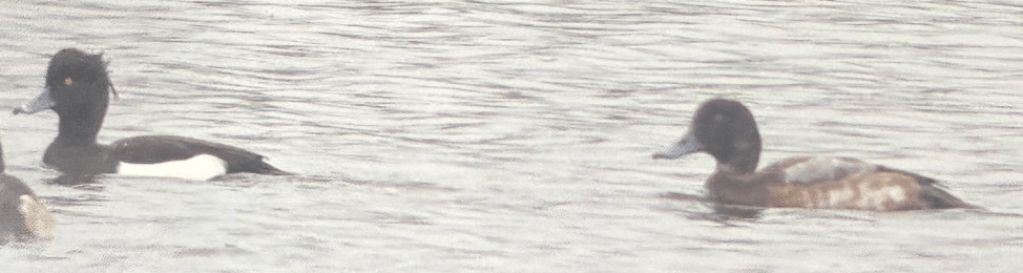
You can just about see all the key differences in the above picture, despite the rather drizzly conditions. The dome head without any hint of a tuft, the bulkier size and profile of the bird, the lesser amount of black in the bill tip and even though it’s an immature bird the grey back feathers of an adult male coming through.
Scaup are a predominantly marine duck that have become increasingly scarce winter visitors in northwest England. In the past small flocks could occasionally be seen off Morecambe and Blackpool. Now it has reached the point where there have been barely a handful in Lancashire this year. This bird is the first in the Fylde in 2025 and first in the park for over four years.
This meant there was a bit of interest in the young drake and local birders began to arrive. I’ve borrowed Tom P’s picture as I didn’t have a camera and was having to resort to my phone. You can see from the first picture just how close it came on occasion. I planned to return to get my own images when the weather was better, but the bird appears to have quickly moved on.
 Natural Selection
Leave a comment